Contributed by: Suzanne Aronyk, MD, CCFP (COE) – View Dr. Aronyk’s bio
Case
Mr. Peterson is an 87-year-old gentleman with a known history of advanced major neurocognitive disorder (Alzheimer’s disease), hypertension and end-stage COPD. He is admitted to hospital for a COPD exacerbation. His current medications include:
- Ramipril 1.25 mg PO OD
- Rosuvastatin 10 mg PO OD
- Trelegy Ellipta (umeclidinium bromide 62.5 mcg + vilanterol trifenatate 25 mcg + fluticasone furoate 100 mcg) one puff once daily
- 5 L home oxygen
- Donepezil 5 mg PO OD
- Ferrous fumarate 300 mg OD
- Vitamin B12 (1000 mcg PO OD)
- Magnesium gluconate 500 mg PO OD
On initial hospital assessment, Mr. Peterson’s Vital Signs are:
- BP: 90/60 mmHg
- HR: 50bpm, regular
- T: 36.5 °C
- SpO2: 84% on 5 L/min
During Mr. Petersen’s admission, it is noted that he does not have a listed Goals of Care Designation (GCD) on his medical record.
Issue
Goals of Care Designations (GCD) are medical orders used to guide the level of intervention for individuals with life-limiting illness. These designations are determined by aligning a patient’s wishes with clinical recommendations.
Canada’s population is aging and individuals are living with higher levels of chronic illness and comorbidity.1 As patient autonomy and the number of available medical interventions increase,1-2 it has become increasingly important to maintain accurate and up-to-date Advance Care Planning documentation. GCDs inform the health care team about a patient’s preferred focus of care and guide individualized prescribing.
Background
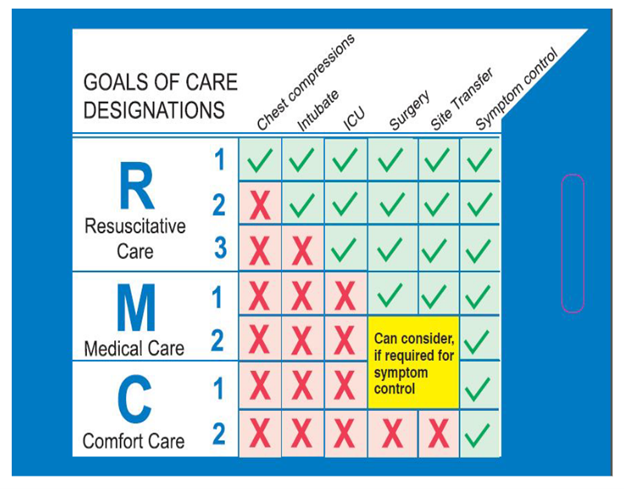
The concept of Goals of Care Designations, or Physician Orders for Life-Sustaining treatment (POLST), emerged from the need for clearer communication around resuscitation preferences. This began with the introduction of Do Not Resuscitate (DNR) orders in the 1970s.3 Since then, various documentation tools have been developed, including the POLST program in the United States4 and multiple versions of GCDs across Canada.5-14 Although classification methods vary most are organized into three categories: Resuscitation (R), Medical Management (M) or Comfort Measures (C) -- see Table 1.6
Table 1
Quick GOC card that AHS EMS are given during orientation15
Goals of Care Designations offer health care professionals an understanding of what a patient would like for their focus of care. Health circumstances change over time, so medical practitioners and patients must continuously reassess the management plan and review whether certain interventions or medications remain appropriate over the course of illness. Studies have shown that establishing Goals of Care with patients leads to higher quality care, including avoidance of unnecessary medical interventions.16 However, barriers, such as limited time for health care providers, inadequate professional training for discussions, and concern for negatively affecting rapport - have been identified as issues that may preclude providers from initiating and engaging in these conversations.16-17
Evidence
While Mr. Peterson is admitted, his medical team speaks with his wife and obtains copies of his Personal Directive and Declaration of Incapacity. His wife is listed as his agent/substitute decision maker. Mr. Peterson has advanced major neurocognitive disorder (FAST 7b)18 and is almost entirely non-verbal.
Mr. Peterson’s medical team broaches the subject of Goals of Care with Mrs. Peterson. She shares that Mr. Peterson consistently expressed strong opinions regarding resuscitative care, stating on multiple occasions that if he ever went into cardiopulmonary arrest, he would not want CPR or “heroic measures” such as intubation or ICU admission. He was open to medical care for reversible conditions such infection or COPD exacerbation but declined invasive measures such as surgery. Following this discussion, Mr. Peterson’s health care team submits an order for an M1 GCD.
Mr. Peterson’s COPD exacerbation is treated with a course of prednisone (50mg PO OD x 7d) and antibiotics (doxycycline 100mg PO BID x 7d). After treatment, he returns to his baseline health status with an SpO2 92-94% (on baseline 5 L/min home O2) but continues to experience bradycardia (HR 40-50 bpm) and hypotension (average 90/60mmHg). His advanced dementia has led to difficulty swallowing medications. After finalizing his GCD, his family requests a medication review to ensure they reflect his current Goals of Care wishes and functional status.
Medication review
His medications are closely considered:
- Ramipril: Discontinued due to persistent hypotension.
- Rosuvastatin: Discontinued after shared decision-making; no history of CVA or MI and limited evidence for prevention in this context.19
- Donepezil: Discontinued after seven years with no perceived benefit; supported by deprescribing guidelines.20
- Ferrous fumarate, vitamin B12 and magnesium gluconate: Discontinued due to sufficient serum levels and increased aspiration risk. Bloodwork will be repeated in several months.
Mr. Peterson remained on his scheduled triple therapy puffer (Trelegy Ellipta) and home oxygen and benefitted from a significantly reduced pill burden.
Recommendation/ Summary
Goals of Care Designations are important orders that help determine the appropriate level of medical intervention for individuals with life-limiting illness. As our aging population continues to increase in complexity and comorbidity, it has become exceedingly important to engage patients in Goals of Care conversations to ensure their wishes are respected throughout their illness trajectory.
Health care teams must continuously reassess a patient’s health status and preferred focus of care to ensure interventions or medications remain appropriate. By aligning medical management with Mr. Peterson’s expressed wishes and clinical status, the health care team was able to reduce unnecessary interventions and optimize his quality of life.
This case highlights the importance of regularly reviewing medications in the context of a patient’s Goals of Care, especially in the setting of advanced illness and functional decline.
References
- Global Health estimates life expectancy and healthy life expectancy [Internet]. World Health Organization; [cited 2023 December]. Available from: https://www.who.int/data/gho/data/themes/mortality-and-global-health-estimates/ghe-life-expectancy-and-healthy-life-expectancy
- Chin JJ. Doctor-patient relationship: from medical paternalism to enhanced autonomy. Singapore Med J. 2002;43(3):152-155.
- Rabkin MT, Gillerman G, Rice NR. Orders not to resuscitate. New England Journal of Medicine. 1976 Aug 12;295(7):364–6. doi:10.1056/nejm197608122950705
- House SA, Schoo C, Ogilvie WA. Advance Directives. In: StatPearls. Treasure Island (FL): StatPearls Publishing; August 8, 2023.
- Medical orders for scope of treatment (MOST) [Internet]. 2019 [cited 2024 Oct 6]. Available from: https://www.interiorhealth.ca/sites/default/files/PDFS/most-orders-for-scope-of-treatment.pdf
- Goals of care designation (GCD) order [Internet]. Alberta Health Services; 2023 [cited 2024 Oct 6]. Available from: https://www.albertahealthservices.ca/frm-103547.pdf
- Saskatchewan medical order for scope of treatment (SMOST) - advance care planning [Internet]. [cited 2024 Oct 6]. Available from: https://www.saskhealthauthority.ca/intranet/departments-programs/quality-safety-and-information/clinical-standards/advance-care-planning-program/saskatchewan-medical-order-scope-treatment-smost-advance-care-planning
- Advance Care Planning Goals of Care. Winnipeg Regional Health Authority; [cited 2024 Oct 6]. Available from: https://professionals.wrha.mb.ca/files/acp-goals-of-care-form.pdf
- Goals of Care [Internet]. Windsor Regional Hospital; [cited 2024 Oct 6]. Available from: https://www.wrh.on.ca/GoalsofCare
- Levels of Care and Cardiopulmonary Resuscitation [Internet]. Sante et services sociaux Quebec; [cited 2024 Oct 6]. Available from: http://msssa4.msss.gouv.qc.ca/intra/formres.nsf/961885cb24e4e9fd85256b1e00641a29/51594518c63d73bc85257f500052736d/$FILE/AH-744A_DT9262(2016-01)D.pdf
- Libguides: Goals of care: Level of intervention (LOI) designations [Internet]. [cited 2024 Oct 6]. Available from: https://library.nshealth.ca/GoalsofCare/LOI
- Goals of Care [Internet]. Health PEI; [cited 2024 Oct 6]. Available from: https://www.princeedwardisland.ca/sites/default/files/forms/goals_of_care_form.pdf
- Health Care Directives. [Internet]. Public Legal Education and Information Service of New Brunswick; [cited 2024 Oct 6]. Available from: https://pomis.legalinfonb.ca/publication-files/Health_Care_Directives_EN.pdf
- Advance Care Planning and Goals of Care Designations [Internet]. Eastern Health ; [cited 2024 Oct 6]. Available from: https://www.easternhealth.ca/wp-content/uploads/2019/11/PRC-002-Advance-Care-Planning-and-Goals-of-Care-Designations-POLICY-1.pdf
- EMS training. Goals of Care (Green Sleeve) - Alberta. Available from: https://deltaemergency.podia.com/view/courses/289d49e7-8c90-4776-8d8c-d889466316a7/1391276-chapter-1-the-professional-responder/4955499-goals-of-care-green-sleeve-alberta
- Choi A, Sanft T. Establishing Goals of Care. Medical Clinics of North America. 2022 Jul;106(4):653–62. doi:10.1016/j.mcna.2022.01.007
- You JJ, Downar J, Fowler RA, Lamontagne F, Ma IW, Jayaraman D, et al. Barriers to Goals of Care discussions with seriously ill hospitalized patients and their families. JAMA Internal Medicine. 2015 Apr 1;175(4):549. doi:10.1001/jamainternmed.2014.7732
- Reisberg B. Functional assessment staging (FAST). Psychopharmacol Bull 24: 653-9, 1988.
- Lipid Management [Internet]. Canadian Stroke Best Practices. Available from: https://www.strokebestpractices.ca/recommendations/secondary-prevention-of-stroke/lipid-management
- Cholinesterase Inhibitor (ChEI) and Memantine Deprescribing Algorithm [Internet]. 2018. Available from: https://cdpc.sydney.edu.au/wp-content/uploads/2019/06/algorithm-for-deprescribing.pdf