Contributed By: Jean Triscott, MD, CCFP, FCFP; Olga Szafran, MHSA – View bios
Case
Mr. Chen is a 93-year-old Cantonese-speaking Buddhist widower who has been in hospital for three weeks with pneumonia and a history of lung cancer, with metastatic disease. He is not responding to medical treatment and is slowly deteriorating. During a family conference with Mr. Chen’s son and daughter, the attending physician, Dr. Jones, discusses goals of care. Dr. Jones advises that Mr. Chen be transferred to palliative care where he will receive comfort and compassionate care, as he approaches death. There will be no resuscitation, i.e., no code, or active medical treatment in the goals of care RMC framework in palliative care. This creates conflict and tension between Mr. Chen’s children and the physician. The children are upset and feel that they cannot agree to no code and no active medical treatment.
Issue
How can effective communication be employed to provide culturally competent and sensitive care to patients?
Background
Canada’s culturally diverse society is comprised of people from many cultures, with different languages, varying socioeconomic status and different understanding of illness and health.
Culture plays an important role in shaping people’s values, beliefs and behaviours, and influences patient-provider interactions.1-3 In the doctor-patient encounter, the patient has a cultural perspective, and the doctor comes with both personal and professional cultural perspectives. Communication between people from different cultures (inter-cultural communication) can result in shared or common understanding (common ground), i.e., they agree about something(s), despite disagreeing about other things.
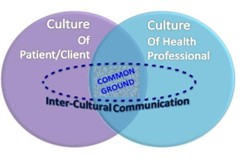
Source: Waugh E, Szafran O, Triscott JAC, Parent R. Cultural Competency Skills for Health Professionals: A Workbook for Caring Across Cultures. Edmonton, AB: Brush Education Inc.; 2014. page 9
When patients and health care providers reach common ground and establish mutual understanding and trust, it improves communication, ensures that the patient’s values and preferences are considered, and leads to better care outcomes.1-3
In health care, cultural competency refers to a health care provider’s ability to understand and respect a patient’s values and attitudes, and consider these when planning and implementing treatment plans. Other closely related terms that may be used include cultural sensitivity, cultural safety, cultural awareness and cultural humility.
Evidence
Cultural factors, which include values, beliefs and norms, play an important role in health care and can affect access to health services of cultural groups,4,5 and the amount and type of care patients receive.6 The lack of cultural competency by health professionals has been attributed to improper diagnosis,7,8 lack of patient compliance,9 inequitable access to health services,10 and legal challenges stemming from misunderstandings.11 The provision of culturally-competent care has been associated with improved quality of care, better communication and enhanced doctor-patient relationships.12-16
Intercultural communication is the ability to communicate effectively with people from diverse cultures. While some personal competencies for intercultural communication are inherent (e.g., respect, self-awareness, emotional intelligence), others can be facilitated using available tools in health care settings.
Tools for cultural understanding and intercultural communication
The goal of intercultural communication is to find common understanding between people from different cultures. Two tools can be used to facilitate intercultural communication:
- BRIDGES Tool
- LEARN Model
BRIDGES Tool is used to gain an understanding of a patient’s cultural perspective.17 When health professionals communicate across cultures, in essence they are building a bridge with the patient. Below are questions health professionals can ask to elicit various aspects of a patient’s cultural perspective.
Beliefs, values, norms
- What do you believe the origin of your health issue to be?
- What cultural aspect do you value the most in your current health situation?
- What would normally be done in your health situation in your culture?
Roles and relationships with family/relatives
- What is your family situation?
- What role do you play in your family or community?
- What roles do each of your family members have in regard to your illness?
Identify language, literacy, communication
- What language do you feel most comfortable speaking?
- What is your highest level of education?
Decision-making methods/practices
- How are decisions normally made in your family?
- Who is involved in family decision making?
Group, community, organizations
- What cultural group do you normally associate with?
- What groups do you belong to or identify with?
Extraordinary issues in health (e.g., end-of-life, childbirth, etc.)
- Are there certain cultural practices associated with your health issue (i.e., at end of life or in a crisis) in your community?
Share, understanding of cultures, reach common ground and compromise
- How do you think we differ on this health issue?
- How are we similar?
- What do you think we have in common?
LEARN Model was advanced many years ago by Berlin and Fowkes18 and is still relevant today. It facilitates intercultural communication by being patient-centered, avoiding stereotypes and developing problem-solving skills to reach common ground.
L = Listen with cultural sensitivity, aware of your patient/client’s cultural perspective.
What do you feel may be causing your problem? What do you feel might be of benefit?
E = Explain your perspective of the health issue.
Use simple language. Avoid medical jargon. Confirm that the patient understands the problem as explained.
A = Acknowledge differences/similarities with your patient/client.
What do you call your problem? Have you taken any medications or herbs? How can I help?
R = Recommend treatment respectfully and sensitively.
Be sensitive to the cultural implications of the treatment plan.
Use culturally appropriate wording.
N = Negotiate an agreement with your patient/client and his/her family or caregiver.
Is there a culturally appropriate way that we can make the treatment plan work for you? Who do you want to be included in your care and medical decisions?
Summary
By using the LEARN and BRIDGES tools and asking relevant questions, Dr. Jones learns that the children feel that they cannot agree with no code and no active medical treatment because this would mean that they are “giving up” and it is their “duty as children” to provide the best possible care for their father. Dr. Jones is honest in explaining that there are limits to medical treatment and that it would be the honorable thing for Mr. Chen to have a peaceful and comfortable passing. The children agree that this would be their father’s wish. The son requests that they be allowed to carry out some cultural end-of-life traditions and rites in their father’s room, to which the hospital agrees. Mr. Chen and his family feel supported and honored to be respected in their norms, beliefs, values and traditions at the end of life.
Acknowledgement: A special thank you to Erica Wright for conducting the literature review.
References
- Brown O, Ten Ham-Baloyi W, van Rooyen DR, Aldous C, Marais LC. Culturally competent patient-provider communication in the management of cancer: An integrative literature review. Glob Health Action. 2016;9:33208.
- Lauwers EDL, Vandecasteele R, McMahon M, De Maesschalck S, Willems S. The patient perspective on diversity-sensitive care: A systematic review. Int J Equity Health. 2024;23(1):117.
- Lu R. Examining provider perspectives surrounding cultural competencies: An integrative review. Nurse Educ Pract. 2025;82:104242.
- Degrie L, Gastmans C, Mahieu L, Dierckx de Casterle B, Denier Y. How do ethnic minority patients experience the intercultural care encounter in hospitals? A systematic review of qualitative research. BMC Med Ethics. 2017;18(1):2.
- Stubbe DE. Practicing cultural competence and cultural humility in the care of diverse patients. Focus (Am Psychiatr Publ). 2020;18(1):49-51.
- Curtis E, Jones R, Tipene-Leach D, Walker C, Loring B, Paine SJ, et al. Why cultural safety rather than cultural competency is required to achieve health equity: A literature review and recommended definition. Int J Equity Health. 2019;18(1):174.
- Pedraza J. Culturally competent approaches to diagnosing ADHD in Hispanic adults and overcoming cultural issues with patients and families. J Clin Psychiatry. 2015;76(5):e14.
- Sagbakken M, Spilker RS, Nielsen TR. Dementia and immigrant groups: A qualitative study of challenges related to identifying, assessing, and diagnosing dementia. BMC Health Serv Res. 2018;18(1):910.
- Aggarwal NK, Pieh MC, Dixon L, Guarnaccia P, Alegria M, Lewis-Fernandez R. Clinician descriptions of communication strategies to improve treatment engagement by racial/ethnic minorities in mental health services: A systematic review. Patient Educ Couns. 2016;99(2):198-209.
- Clifford A, McCalman J, Bainbridge R, Tsey K. Interventions to improve cultural competency in health care for Indigenous peoples of Australia, New Zealand, Canada and the USA: A systematic review. Int J Qual Health Care. 2015;27(2):89-98.
- Bresnahan M, Zhuang J. Culturally safe healthcare: Changing the lens from provider control to patient agency. J Commun Healthc. 2024;17(3):[244-53.
- Betsch C, Bohm R. Cultural Diversity calls for culture-sensitive health communication. Med Decis Making. 2016;36(7):795-7.
- Estrada RD, Messias DK. A scoping review of the literature: Content, focus, conceptualization and application of the national standards for culturally and linguistically appropriate services in health care. J Health Care Poor Underserved. 2015;26(4):1089-109.
- Handtke O, Schilgen B, Mosko M. Culturally competent healthcare - A scoping review of strategies implemented in healthcare organizations and a model of culturally competent healthcare provision. PLoS One. 2019;14(7):e0219971.
- Paternotte E, van Dulmen S, van der Lee N, Scherpbier AJ, Scheele F. Factors influencing intercultural doctor-patient communication: A realist review. Patient Educ Couns. 2015;98(4):420-45.
- Williamson M, Harrison L. Providing culturally appropriate care: A literature review. Int J Nurs Stud. 2010;47(6):761-9.
- Waugh E, Szafran O, Triscott JAC, Parent R. Cultural Competency Skills for Health Professionals: A Workbook for Caring Across Cultures. Edmonton, AB: Brush Education Inc. 2014.
- Berlin EA, Fowkes W. A teaching framework for cross-cultural health care. Application in family practice. West J Med 1983;139(6):934-8.