
PCPCM Compensation Overview
Compensation under the Primary Care Physician Compensation Model (PCPCM) consists of three components: encounters, time and complexity-adjusted panel payments.
For full details on billing in the model, please refer to the PCPCM Operations Manual.
Billing for Time
PCPCM Billing BasicsBilling for Encounters
PCPCM Billing BasicsWeekly Statement Guide
PCPCM Billing BasicsPayment Schedule
PCPCM Payment Schedule- PCPCM utilizes roughly 94% of standard fee-for-service (FFS) codes. They are referred to as In-basket services, prorated at 68.5% of FFS value
- All other billable codes are considered out-of-basket services and are paid at 100% of FFS value
- Procedure tray fees are paid at 100% value
- Complexity modifiers and BCP payments are not eligible
- RRNP variable rate payments apply only to encounter payments, at 100% of FFS value
General Time Billing Rules
- Billing for time requires the Non-Patient Specific Unique Lifetime Identifier (ULI): 10814-7612. To set this up in your EMR, see Billing for Time by EMR
- Physicians can claim time, including time with out-of-province patients, when the majority of patients seen during the day are part of their panel
- Direct Care Codes (PC001, PC003 & PC004) cannot be claimed for time spent on out-of-basket services, excluded services and encounters with out-of-country patients. To avoid double recovery, track and subtract time spent on excluded services before submitting claims.
- Up to 20% of total time-based billing per fiscal year can be assigned to premium-rate Direct Care Codes (PC003 & PC004)
- Direct Care Codes correspond with when the patient encounter took place
- E.g. If charting between after-hour appointments, direct care time can only be claimed for charting if the associated encounter occurred that evening
- Submitting more than one claim for the same PCPCM time code in a single day results in rejections. Physicians should submit the time code only once per day, ensuring the claim accurately reflects the total number of calls and time. If additional time must be recorded after the initial submission, submit a Change claim (Action Code C) to update the number of calls.
- Sample day sheet: How to Calculate Time
- Holidays are defined by the SOMB Governing Rules
PCPCM Time Codes, Usage & Rates
| Time Code | Usage | Rate (per 15 minutes) |
| Direct Care PC001 |
Monday - Friday Max calls per day: 40 |
$26.25 |
| Indirect Care PC002 |
Unrestricted Max calls per day: 44 |
$26.25 |
| After-hours Direct Care PC003 |
Monday - Friday Max calls per day: 24 |
$48.18 |
| Weekend & Holiday Direct Care PC004 |
Weekends & Holidays Max calls per day: 64 |
$48.18 |
PCPCM Time Codes & Eligible Activities
- With PCPCM, virtual care should be a complement to in-person care. Virtual-only care clinics cannot use PCPCM codes (see clause 2.3 of the Ministerial Order and CPSA guidelines)
- Phone calls to patients are considered direct care and can originate from the clinic or the physician's home.
|
Time Code & Usage |
Eligible Activity |
| Direct Care PC001 |
Direct care to patients
|
| Indirect Care PC002 |
Indirect care
Claims are not limited to services found in the SOMB |
| After-hours Direct Care PC003 |
Direct care to patients
|
| Weekend & Holiday Direct Care PC004 |
Direct care to patients
|
Statement of Assessment Sample
Lines highlighted in yellow represent your submitted time-based codes and payments.

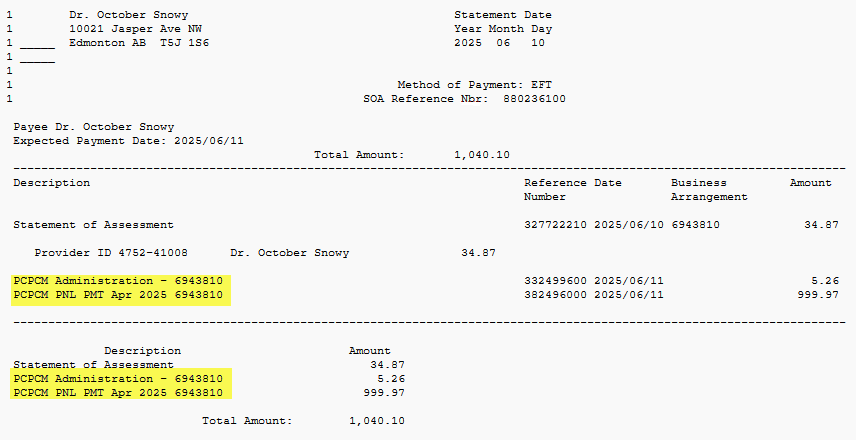
Statement of Account Sample
The areas highlighted in yellow represent your Clinic Practice Management payments (Administration) - a 10% top-up and Monthly PCPCM Panel Complexity payments.
Practice Management payments are calculated based on your approved PCPCM time codes.
Click here for more information on how your Panel Complexity Payments are calculated.
Explanatory Codes
|
Code |
Description |
| 99C | Reflects PCPCM discounted rate for in-basket codes paid at 88.5% of FFS value |
| 99B |
*When time-based codes are submitted with an FFS BA, they are rejected. |
| 99D | *When the wrong ULI is used, claims are rejected. |
*Physicians can resubmit rejected claims within 90 days of when the claim last appeared as rejected on their Statement of Assessment.