
Starting in April 2026, Primary Care Physician Compensation Model (PCPCM) physicians may see changes to their panel payment calculation. Patients in conflict with other providers may be subtracted from the monthly payment calculation.
Evidence suggests that health outcomes are improved when patients have an established relationship with a family physician who quarterbacks their care. Managing CPAR conflicts strengthens those relationships and is a foundational step towards building a stronger Patient’s Medical Home.
Reducing conflicts is important for all primary care providers, but PCPCM physicians have additional reasons to prioritize this work. Due to the panel component of PCPCM compensation, physicians are expected to practice good panel management, which includes implementing a process to achieve and maintain a low conflict rate (defined as the percentage of their paneled patients that have a conflict).
Why Work on Conflicts Now?
It’s good for patients and providers:
-
Improves care continuity and patient attachment
-
Reduces the risk of information being copied on or routed to the wrong provider
-
Ensures others in the system can correctly identify the primary care provider
-
Reduces duplicate referrals, diagnostics, prescriptions, etc.
-
Improves the accuracy of HQA reports
It’s a requirement of PCPCM:
-
The PCPCM Operations Manual states that physicians must “commit to develop and/or maintain panel management processes that address panel conflicts and demographic mismatches.”
It takes time:
-
PCPCM panel payments may not be issued for patients in conflict after Mar 31, 2026
-
If your conflict rate is high, it could take several months to address them all
Conflict Definition & Conflict Report
When a patient is paneled to more than one CPAR panel, the patient is in conflict. This occurs when a patient is attached to more than one primary care provider.
An authorized CPAR Panel Administrator can download monthly CPAR Conflict Reports for a physician. These reports can be used to begin resolving conflicts and contain a list of all patients in conflict, along with details about the conflicting provider and clinic.
Getting Started with Reducing Conflicts
Physicians should work with their teams to implement a structured, ongoing Conflict management process. Here's how to get started:
Physician To-Do List
-
Ask your Panel Administration (PA) for a monthly Conflict Rate update via the CPAR Conflict Report.
-
Set a strategy with your team for prioritizing Conflicts and a timeline for reaching a lower target Conflict Rate.
-
Discuss how involved you'd like to be - you may want to be part of patient-level discussions or be provided an update once conflict resolutions are in progress or have been resolved.
-
Ensure your team understands how to use your EMR to panel and unpanel patients from CPAR.
- When providing episodic care, such as referred services and walk-in visits, those patients should not be added to your CPAR panel.
- Ensure patients are paneled only when they receive the majority of their longitudinal, relationship-based family medicine care at your clinic.
-
Use AMA's template to develop telephone scripts for patient conversations about continuity and attachment.
-
Understand how and when unresolved conflicts may affect your PCPCM panel payments.
Team To-Do List (Panel Admins, MOAs, etc.)
-
Download and sort the CPAR Conflict Report based on established priorities and processes. This report is available on the 24th of each month.
-
Distribute the sorted report to the physician and/or team members assigned to resolve Conflicts.
-
Contact patients in Conflict using an approved telephone script and record the patient's response and any action taken in their chart. If the patient confirms they are no longer your physician's patient, unpanel them in the EMR. If the patient confirms they are no longer a patient of the conflicting physician, fax the conflicting clinic and request that the patient be unpaneled.
-
Contact the physician when cases are complex or next steps are unclear.
-
To meet ongoing eligibility, physicians must maintain at least 500 patients on their PCPCM panel. Alert the physician when Conflict resolution work risks the panel dropping below the minimum requirements.
- Understand how to unpanel patients when conflicting clinics have confirmed a patient's attachment and request that they be removed from the physician's CPAR panel.
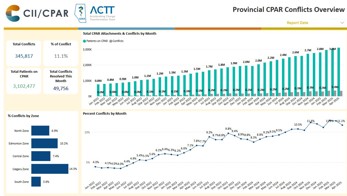

Known Issues with Conflicts & PCPCM
CII/CPAR was designed to improve care continuity, not as a funding model component. The Alberta Medical Association (AMA), Alberta Health and other interested parties are currently working to adapt the system for PCPCM to ensure panel payments are fair, while maintaining its original functions.
Updates on new policies and conflict-related processes will be published here, supporting physicians and teams in reducing conflicts while also:
- Promoting stronger care continuity and patient-provider attachments
- Keeping physicians satisfied and engaged with the model
- Reducing the administrative burden of managing conflicts where possible
Conflicts FAQ
The AMA and AH are working on ways to help clinics manage conflicts for which the conflicting provider has not unpaneled despite several requests. The good news is that experience suggests that this situation is uncommon for most conflicts. The current recommendation is to move on to resolving other conflicts while AMA and AH considers additional ways to address these situations.
No. This is an example of appropriate “dual-attachment”. In these cases, it is important for both of these physicians to panel the patient in CPAR to ensure good care continuity. AMA and AH will work on how to maintain this kind of appropriate dual-attachment while minimizing the financial impact on PCPCM physicians.
AMA and AH, in consultation with other interested parties and experts, will have further guidance on this question before April 1, 2026, when conflicts impact PCPCM physician compensation.
Resources for Conflict Management Process Development
Fax Template: Notification to Change Primary Provider
Notification to Change Primary ProviderSample fax template to send to conflicting clinics. This can be personalized for each clinic.
Sample Script for CPAR Conflict Calls
Sample Script for CPAR Conflict CallsA sample script that can be used for CPAR Conflict calls
CII/CPAR Go-Live & Beyond
CII/CPAR TrainingAn online course that covers conflict management in great detail.
CPAR Panel Administrator Handbook
CPAR Panel Administrator HandbookSee page 7 for conflict management guidance.
CII/CPAR Team Toolkit
CII/CPAR Team Toolkit for Primary CareSee Module 5 for CII/CPAR guidance in primary care settings.
CII/CPAR Roles and Responsibilities
CII/CPAR Roles and ResponsibilitiesRoles, responsibilities, and tasks of the practice facilitator, site liaison, CPAR access administrator and CPAR panel administrator.
How to Unpanel Patients from CPAR by EMR
How to Unpanel Patients from CPAR by EMRThis article describes how to unpanel a patient in the clinic Electronic Medical Record (EMR), in order to remove them from the provider’s CPAR panel.
Continuity Posters
Continuity PostersPrintable posters for clinic walls to help start conversations with patients about the importance of attachment and continuity of care.
PCPCM Operations Manual
PCPCM Operations ManualSee Section 6.4: Panel Conflicts